

How To Repair Gelcoat Pitting On My Rv
How to Restore Gelcoat on a Boat
The outer surface of a fiberglass boat is normally a special resin called gelcoat. Gelcoat has trivial structural value — the underlying laminates of resin-saturated glass fabric provide that — but gelcoat protects the hull and gives information technology its colour and shine.
When the gelcoat was originally sprayed into the hull mold, it — like all gels — took on the shape and texture of the mold surface. The ultra high gloss most new boats exhibit is due entirely to the highly polished, mirror-like surface of the mold used in the original construction of the boat.
Time and exposure eventually erode the relatively soft surface of gelcoat, leaving it deadening and chalky. Fortunately, the gloss ordinarily tin be restored.
How To Clean Fiberglass
The first stride in restoring the gloss to dull gelcoat is always a thorough cleaning. Add a cup of detergent to a gallon of water — warm h2o is ameliorate — and use a sponge to wash the surface with this solution. Be sure to protect your hands with prophylactic gloves.
If mildew is present, add a loving cup of household bleach to your cleaning solution. Difficult stains like fish blood and waterline scum may require the direct application of a concentrated cleaner formulated for fiberglass. Rinse the clean surface thoroughly and let it dry.
How To Degrease Gelcoat
For dependable results from wax or smooth, the gelcoat surface must be completely costless of oil and grease. Detergents frequently fail to fully remove these contaminants from porous gelcoat. Wipe the entire surface with a rag soaked in MEK (preferred) or acetone, turning the rag often and replacing it when y'all run out of make clean areas. Again, protect your skin with thick safety gloves.
How To Wax A Boat
Keeping gelcoat coated with wax-starting when the gunkhole is new — is the all-time way to prolong its life. Regularly waxed gelcoat can retain its gloss for fifteen years or more than. The real purpose of a glaze of wax is to protect, but wax also has restorative properties if the gelcoat is not also desperately weathered.
Awarding instructions vary among brands, but in general yous apply the wax with a cloth or cream pad using a round motility. Let the wax dry to a haze, then vitrify away the backlog with a soft textile, such as an quondam bath towel. The remaining wax fills microscopic pitting in the gelcoat and provides a new, smooth, reflective surface.
How To Buff A Boat
Smooth is not a coating, just rather an abrasive — similar extremely fine sandpaper. Polishing removes the pitted surface rather than coating it. Use a soft fabric to use smooth to a small expanse at a time, rubbing with a circular motion until the surface becomes glassy. Afterward polishing, y'all should apply a coat of wax to protect the surface and improve the gloss. Some polish products include wax in their formulations.
Using Rubbing Compound
If the gelcoat is weathered and so badly that smoothen fails to restore its shine, you will need the stronger abrasives rubbing compound contains. Wax on the surface can cause the compound to cutting unevenly, so starting time remove all wax by "sweeping" the surface in one direction — non back and forth — with rags saturated with dewax solvent or toluene.
Select a rubbing compound formulated for fiberglass and use it exactly like polish, rubbing information technology with a round motion until the surface turns burnished. The gelcoat on your boat is about 10 times as thick as the pigment on your auto, and so compound shouldn't cut all the way through it every bit long as you are careful not to rub in 1 place too long. If the gelcoat starts to wait transparent, stop.
Subsequently the surface has been compounded, polish information technology, then coat it with wax and buff information technology. Providing the gelcoat has an acceptable thickness — your boat might have been compounded previously — this process will restore the shine to fiberglass in virtually any status.
Practice Y'all Need an Electrical Buffer?
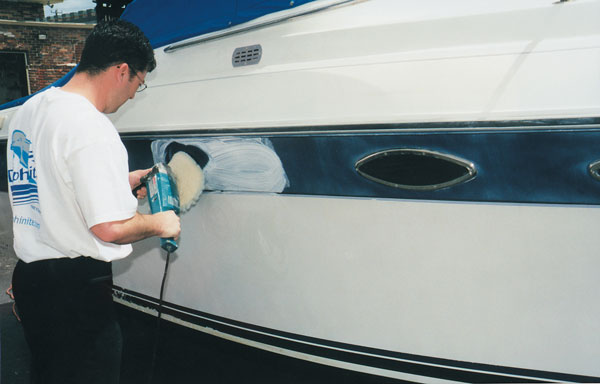
You lot tin can wax, polish, and compound by hand, but on anything but the smallest boat, your arm is going to get very tired. An electric buffer takes much of the work out of keeping a boat shining and is less expensive and less painful than elbow replacement.
Electric buffers operate at relatively slow speeds, so don't try to "make exercise" with a polishing bonnet fitted to a deejay sander or a sanding pad chucked into a drill. You will either ruin the surface or ruin the tool. A buffer with an orbital motion will leave fewer swirl marks.
Should I Use Gelcoat Restorer?
In recent years a number of products accept come on the market that merits to restore the surface of the gelcoat. Restorer formulations renew the gloss in essentially the same fashion every bit wax — by providing a new shine surface — but without the need for buffing. Results tin be dramatic, simply because restorers are a plastic (acrylic) coating — like to urethane varnish — they can wear off, flake off, and occasionally discolor. Restorer kits typically include a prep wash and sometimes a polish in addition to the restorer. A specialized stripper for removing old sealer is also necessary.
At that place are variations in the recommended awarding, merely in general it is the same as already described — make clean, smoothen, and coat. The acrylic sealer is normally h2o-thin, so applying it to the hull is much easier than, say, paste wax. And it dries to hard film, so no buffing is needed. Nevertheless you practice have to apply several coats — five is typical — to get a good shine. If the product you take selected doesn't include an applicator, use a sponge or a soft cloth to wipe the sealer onto the gelcoat. Drying times are brusque, and so subsequent coats can by and large exist applied almost immediately.
A multicoat application can restore the smooth to weathered gelcoat for up to a year, merely when it is time to renew it, you lot will need to remove the onetime sealer using the special stripper supplied in the kit (or available separately). Apply five fresh coats of sealer and your gunkhole should shine for another year.
Author
Don Casey
Contributor, BoatUS Magazine
Don Casey has been one of the near consulted experts on boat intendance and upgrades for 30 years, and is one of the BoatUS Magazine's console of experts. He and his wife cruise aboard their 30-footer office of the year in the eastern Caribbean. His books include Don Casey's Complete Illustrated Sailboat Maintenance Manual, and the recently updated This Old Boat, the bible for do-information technology-yourself boaters.
BoatUS Mag Is A Benefit Of BoatUS Membership
Membership Benefits Include:
-
Subscription to the print version of BoatUS Magazine
-
4% back on purchases from West Marine stores or online at WestMarine.com
-
Discounts on fuel, transient slips, repairs and more at over 1,200 businesses
-
Deals on cruises, charters, car rentals, hotel stays and more than…
-
All for merely $25/year!

Source: https://www.boatus.com/expert-advice/expert-advice-archive/2012/july/how-to-restore-gelcoat-on-a-boat
Posted by: velezyoursou.blogspot.com
0 Response to "How To Repair Gelcoat Pitting On My Rv"
Post a Comment