

Can You Repair Yellowing Epoxy
Click hither to view 3rd party yellowing test data featuring diverse popular epoxy resin brands.
Chances are if you've landed on this page, you've had a beautiful slice of fine art plough yellow later on using a resin product that's not specifically formulated for use over creative projects. Total bummer. Hither's why it happened and how to avoid it for next time.
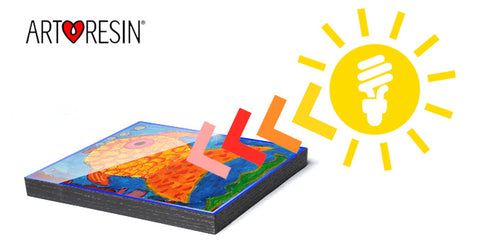
The Effects of UV Light on Epoxy Resin
If yous aren't using ArtResin epoxy resin then your work is in real danger of discoloration from the natural environment. UV light is to arraign for changes to cured epoxy resin over fourth dimension. When UV light hits the resin—either directly or indirectly—information technology degrades the polymers. Although this degradation from UV light is a natural process (UV light is typically always harmful to everything on earth over time), it causes observable, undesirable, aesthetically displeasing characteristics, such every bit:
- gloss loss
- de-lamination
- cracking
- chalking
- YELLOWING
A UV stabilizing amanuensis can be added to epoxy resin formulas to mitigate these effects. UV stabilizers are very effective at preventing gloss loss, de-lamination, cracking and chalking, but they merely filibuster discoloration. In other words, yellowing is still inevitable with a UV stabilizer alone. Yellowing first presents every bit a light tone all over, then progressively darkens until information technology reaches a night brown-yellow hue. Yellowing will be accelerated with exposure to UV light. A resined slice that is placed outside volition more often than not reach its dark brown-xanthous color within 24 hours. Artwork that is kept indoors will brainstorm to discolor generally inside 6 months to a year if information technology was coated in a resin product that independent simply a UV stabilizer. If the resin did not contain a UV stabilizer at all, it volition accomplish a night yellowing much faster, within approximately 2-3 months. Discoloration has also been demonstrated in pieces that have been kept in complete darkness.
* It should be noted that yellowing can occur equally a result of an undesirable interaction between Titanium Dioxide (found in white pigments) and ANY brand of epoxy resin.
All Epoxy Resins Are NOT Created Equal
In that location are many, many uses for epoxy resin, only one of which is equally a clear blanket for artwork and other creative applications. Many epoxy resin products on the marketplace are sold every bit adhesives and about are intended for industrial use, not abode/studio use. Many resins are made for the marine manufacture because epoxy is a durable, waterproof product. In most cases, epoxy resins are not formulated specifically to maintain clarity over the long term, as artists require. Further, almost resins are considered a hazardous material due to their chemic composition; they are intended for use in industrial settings where hazmat suiting is readily available and required. Any resin that rapidly yellows is non adequately formulated for use over artwork. Any creative person thinking of using resin over their artwork should certainly choose a production that has been formulated for artistic purposes, namely that it is both UV and HALS stabilized, and deemed non-toxic when used as directed and safety for home utilise in a well ventilated area. See our SDS for more than information.
How To Protect Your Artwork Against Yellowing
UV stabilizers are non enough to forestall yellowing in epoxy resin. If you are coating pieces of art—or anything artistic, special and of import—and so you need a product that contains an additive chosen 'HALS', in addition to a UV stabilizer. HALS stands for Hindered Amine Low-cal Stabilizer. It's job in the formula is solely to address yellowing. How does information technology do this? HALS scavenges radicals that are produced with UV lite exposure, thus diminishing the deposition cycle that causes yellowing. It's protection abilities has been demonstrated time and once more since information technology came into beingness in the 1960s. A UV stabilizer is still necessary to protect against the other bug that event from UV light degradation, however HALS is the number i agent that works to accost yellowing.
...So what epoxy resin production is peculiarly formulated for creative projects? that contains both an HALS and a UV stabilizer? that has been deemed non-toxic when used as directed and safe for domicile use? that is an like shooting fish in a barrel 1:1 mixing ratio, and that produces a gorgeous, glossy end? It'due south ArtResin.
Why Epoxy Hardener Sometimes Changes Color in the Bottle
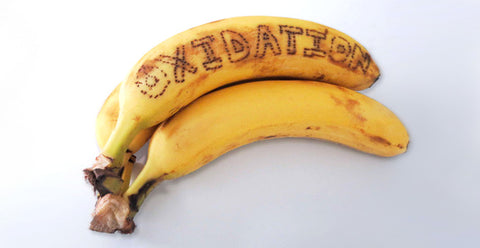
If y'all've institute that your epoxy hardener has discolored in the bottle, this is caused by oxidation, not UV lite. The hardener volition yellow in its liquid land more quickly once the bottle has been opened because it has been exposed directly to oxygen, and this will always exist more noticeable in larger containers (just every bit how the bounding main looks blueish simply a cup of water looks articulate). It can still yellow very slightly if unopened due to the fact that the HDPE plastic bottles it comes packaged in does exhale a lilliputian, assuasive oxidation to occur. For this reason, epoxy resins volition e'er accept a shelf life. Once a product has begun to yellow in the canteen, it can still be used (i.e. it will still cure properly). Information technology will e'er appear less yellowish on a piece due to the fact it must be mixed with an equal part of resin thereby diluting it, and the product volition exist spread out in a thin layer making any appreciable discoloration much less observable.
Learn more about why your resin looks xanthous.

Source: https://www.artresin.com/blogs/artresin/41958017-why-do-some-brands-of-epoxy-resin-turn-yellow
Posted by: velezyoursou.blogspot.com
0 Response to "Can You Repair Yellowing Epoxy"
Post a Comment